
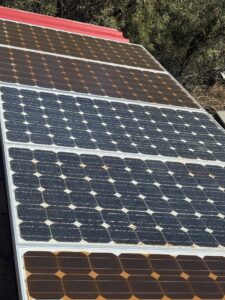
What Happens When You Have a Bad Solar Panel in a String? And What Can You Do When That Panel Is No Longer Available?
Solar pumping systems are built to last a long time. It is not uncommon for solar arrays powering pumps to run for decades with minimal issues. But like any piece of equipment exposed to weather, heat, and electrical load, problems can eventually show up. One of the most common issues people encounter in the field is a single bad panel in a series string.
Understanding what happens when that occurs and how to deal with it when the original panels are no longer available is important for anyone maintaining or troubleshooting a solar pumping system.
How Panels Work in a String
In many solar pumping installations, panels are wired in series to create a string. When panels are wired this way, their voltages add together while the current stays the same. For example, ten 40 volt panels wired in series create a string that produces roughly 400 volts.
Because the current flowing through the string must pass through every panel, the entire string is only as strong as its weakest panel.
If one panel develops a problem, it affects the performance of the entire string.
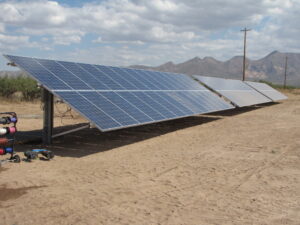
What Happens When a Panel Goes Bad
A bad panel in a string can show up in several ways depending on the failure mode. Some of the most common issues include:
Reduced Output
If a panel begins to degrade or develops internal resistance, it may still pass current but not at the same level as the others. Since current is limited by the lowest producing panel in a series string, the entire string output drops.
Open Circuit Failure
If a panel fails completely open, the entire string stops producing power. Because current cannot pass through that panel, the whole string is interrupted.
Hot Spots or Internal Damage
Cracked cells, failed solder joints, or moisture intrusion can create hot spots. These can cause intermittent operation, erratic voltage behavior, or progressive panel failure.
In many solar pumping systems, this shows up as reduced pump performance, inconsistent pumping hours, or sudden system shutdown.
Diagnosing a Bad Panel in the Field
Troubleshooting usually starts by measuring the string voltage and current.
Common diagnostic steps include:
-
Measuring open circuit voltage of the string
-
Measuring operating voltage under load
-
Testing individual panel voltages
-
Using thermal imaging to identify hot spots
-
Temporarily isolating panels to identify the weak link
Often, the bad panel will stand out immediately because its voltage or temperature behavior is different from the others.

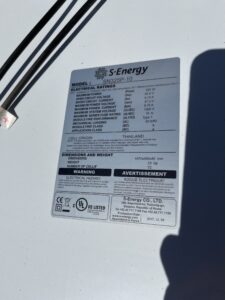
The Real Challenge: Replacement Panels Are No Longer Available
Solar technology moves fast. Panel models are constantly changing, and manufacturers regularly discontinue products.
This means that when a system installed ten or fifteen years ago needs a replacement panel, finding the exact same model can be nearly impossible.
But the system can still be repaired.
Option 1: Replace the Panel with a Similar Voltage Panel
The most important characteristic when replacing a panel in a series string is operating voltage (Vmp).
If the replacement panel has a similar operating voltage and current rating, it will typically work fine in the string.
Small differences in wattage are usually acceptable as long as voltage characteristics are close.
Things to watch for:
-
Match panel voltage as closely as possible
-
Make sure current rating is not significantly lower than the other panels
-
Physical mounting compatibility
In most cases, replacing with a modern panel that has similar electrical characteristics works well.
Option 2: Remove the Bad Panel and Adjust the System
In some systems, especially those with voltage margin, removing the bad panel entirely may still allow the system to operate.
The controller or pump may tolerate a slightly lower input voltage while still functioning properly.
This is often a quick field solution when a replacement panel is not immediately available.
However, this depends on the system design and should be verified against controller voltage requirements.
Option 3: Rebuild the Entire String with Modern Panels
If several panels have degraded or if replacements are extremely mismatched, the best long term solution may be replacing the entire string.
Modern solar panels are typically higher wattage and more efficient than older modules. In many cases, fewer panels can produce the same power as the original array.
This approach can improve reliability and performance while simplifying future maintenance.
Preventing Future Problems
While panel failures are relatively rare, there are a few practices that help extend array life:
-
Proper mounting that minimizes frame stress
-
Protecting wiring and connectors from damage
-
Ensuring good ventilation behind panels
-
Periodic inspection for cracked glass or discoloration
Most importantly, documenting the electrical characteristics of the array when it is installed makes troubleshooting much easier years later.
Final Thoughts
A single bad panel can reduce the performance of an entire solar string, but it does not mean the system is finished.
With some basic testing and a good understanding of panel electrical characteristics, systems can almost always be repaired even when the original panels are no longer available.
Solar pumping systems are designed for durability. With the right troubleshooting approach, they can continue operating for many years beyond the life of the original components.