
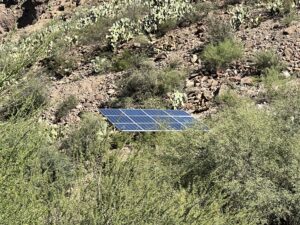
Solar Panel Positioning
Why Location Matters More Than You Think
In solar pumping systems, panel placement is everything.
You can buy the best pump and controller on the market, but if your panels are positioned poorly or exposed to shade, performance will suffer. Water output is directly tied to how well your array is located.
This is not theory. It shows up in gallons per minute.
The Simple Truth
Sunlight in equals water out.
Anything that reduces available sunlight reduces pump performance.
Positioning determines how much sunlight you capture. Shading determines how much you lose.
If either is wrong, your system will underperform.
Panel Positioning Fundamentals
1. Face True South
In North America, panels should face true south for maximum daily exposure.
Not magnetic south. True south.
Even small directional errors can reduce production, especially in winter months when the sun path is lower.
2. Tilt Matters
Tilt angle affects how directly the sun hits the panel.
General rule:
• Summer heavy water demand favors a slightly flatter tilt
• Year round performance favors a tilt close to your latitude
In pumping systems, summer water production is usually the priority. Position accordingly.
3. Avoid Low Ground Placement
Mounting panels too low can introduce problems:
• Vegetation growth shading the lower edge
• Snow buildup
• Mud splash and debris
• Livestock interference
Clearance and visibility matter more than people think.
Understanding Shading in Solar Pumping
Shading is the silent performance killer.
Here is what most people do not realize:
A small shadow on one part of a panel can reduce the output of the entire string.
Solar panels are made of multiple cells wired together. When one cell is shaded, it restricts current flow. The entire series string drops to the level of that shaded cell.
In pumping systems, that drop means:
• Slower pump speed
• Lower flow rate
• Later startup
• Earlier shutdown
• Reduced daily water volume
There is no grid to compensate. The pump only runs on what it receives.
Partial Shade vs Full Shade
Full shade reduces output in a predictable way.
Partial shade creates imbalance and can cause voltage instability. Even with bypass diodes, you lose production and may fall below the minimum voltage required to start the pump.
In real terms, that can mean the difference between filling a tank and coming up short.
The Most Common Shading Mistakes
Most shading issues are not obvious at installation.
Common sources include:
- Growing trees
- Fence posts
- Windmill towers
- Power poles
- Tank stands
- Canyon Walls
- Improper row spacing
- Seasonal sun angle changes
The dangerous part is this:
A system can perform well the first year and decline slowly over time as trees grow or grazing patterns shift.
Shade moves. Systems do not.
Morning and Evening Losses Add Up
Many installers dismiss early and late day shading.
That is a mistake.
If your system loses one hour in the morning and one hour in the evening, you may lose twenty to thirty percent of daily water production.
For livestock and irrigation systems, that is not minor.
Daily runtime equals daily water.
Designing for Reliability
If shading is unavoidable, plan for it.
• Choose the clearest possible location, even if it means running longer pipe
• Increase array size to compensate for unavoidable losses
• Separate arrays when possible to reduce string impact
• Check seasonal sun paths, not just summer noon
Water reliability is more important than saving a few feet of trenching.
A well positioned system will outperform a poorly placed oversized system every time.
Final Thought
When a solar pump underperforms, most people blame the pump.
Many times, the problem is panel related and can include positioning and/or shading.
Before replacing equipment, look at the sky. Look at the horizon. Look at the shadows.
Solar pumping rewards good placement and punishes shortcuts.
Get positioning right first. Everything else becomes easier.