
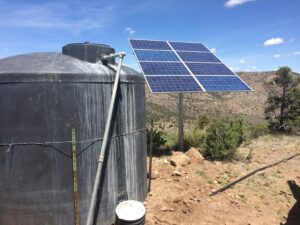
How Much Water Can a Solar Pump Deliver?
One of the most common questions about solar water pumping systems is how much water a solar pump can deliver per day. The answer depends on sunlight, total dynamic head, pump type, and solar array size.
Unlike traditional electric pumps, a solar water pump does not produce a fixed flow rate. Output changes throughout the day as sunlight increases and decreases. Understanding what affects solar pump water output helps set realistic expectations and ensures proper system sizing.
What Determines Solar Pump Water Output
Available Sunlight and Peak Sun Hours
Solar water pumps operate directly from solar panels. As solar irradiance increases, pump speed and water flow increase. As sunlight decreases, flow drops.
Daily water production depends on:
-
Peak sun hours at your location
-
Seasonal changes in daylight
-
Cloud cover and shading
-
Solar panel tilt and orientation
Because solar pump output varies throughout the day, most systems are designed to pump water into storage tanks for later use.
Total Dynamic Head and Lift
Total dynamic head is one of the most important factors affecting solar pump performance. It includes:
-
Vertical lift from the water source
-
Pressure requirements at discharge
-
Friction losses from pipe length and fittings
As total head increases, flow rate decreases. A solar pump lifting water fifty feet will deliver significantly more gallons per minute than the same pump lifting water three hundred feet.
In surface transfer pump applications, this becomes especially important. Many systems pull water from one tank and push it to another location, often uphill. When pumping uphill from tank to tank, the pump must overcome elevation gain plus pipe friction losses. Friction Loss Calculator The greater the vertical rise, the lower the daily water delivery for a given pump and solar array size.
Accurately calculating total lift is critical for estimating solar pump gallons per day.
Pump Type and Application
Different solar pump designs perform differently depending on flow and lift requirements. Solar Water Pumps
Submersible solar pumps are typically used in wells and are designed to push water upward efficiently at moderate to high lift.
Surface solar pumps are commonly used as transfer pumps. They are installed near a water source and move water horizontally or uphill. Surface pumps are frequently used for:
-
Tank to tank water transfer
-
Irrigation supply from reservoirs
-
Livestock watering distribution systems
-
Pressure boosting applications
Centrifugal pumps generally provide higher flow at lower to moderate lift. Positive displacement pumps provide consistent flow at higher lift but usually at lower volume.
Selecting the right pump type for your required lift and daily water demand is essential for maximizing solar pump performance.
Solar Panel Array Size
The size of the solar array directly affects how much water a solar pump can deliver per day.
A properly sized solar array allows:
-
Earlier startup in the morning
-
Longer daily runtime
-
Stronger performance during peak sunlight
An undersized array limits daily water production, especially in higher lift or high demand systems.
Matching panel wattage to pump requirements is a key part of solar pump system design.
Typical Solar Pump Gallons Per Day
Actual water output varies by system design, but general ranges under good sunlight conditions include:
Small low flow systems may produce several hundred gallons per day.
Moderate livestock watering systems often deliver one thousand to five thousand gallons per day.
Larger agricultural irrigation systems can produce five thousand to twenty thousand gallons per day or more, depending on lift and solar resource.
These numbers assume proper solar pump sizing and adequate peak sun hours.
Why Solar Pump Output Changes Daily
Solar water pump performance naturally varies from day to day due to:
-
Changing sunlight intensity
-
Seasonal sun angle differences
-
Water level fluctuations in wells
-
Temperature effects on solar panel efficiency
Designing with adequate water storage allows a solar pumping system to handle these normal variations.
How to Estimate Solar Pump Water Production
To estimate how much water your solar pump can deliver per day, you need:
-
Required daily water volume
-
Total dynamic head
-
Average peak sun hours
-
Pump performance curve at your calculated lift
Pump performance curves show gallons per minute at specific head levels. Multiplying expected flow by usable sun hours gives a realistic estimate of daily water production.
For a detailed explanation of calculating lift and selecting equipment, see the solar pump sizing guide.
Final Thoughts on Solar Pump Water Output
A solar water pump can deliver significant water volume when properly designed. Daily output depends on sunlight, total lift, pump design, and solar array sizing.
Whether you are pumping from a deep well, transferring water between tanks, or pushing water uphill to a remote location, accurate head calculation and proper system design determine how many gallons per day your system will produce.
When solar pump systems are sized correctly, they provide reliable and efficient water delivery across a wide range of agricultural, livestock, irrigation, and remote water applications.
Contact Sun Pumps for assistance in Building your Solar pumping system Contact SunPumps